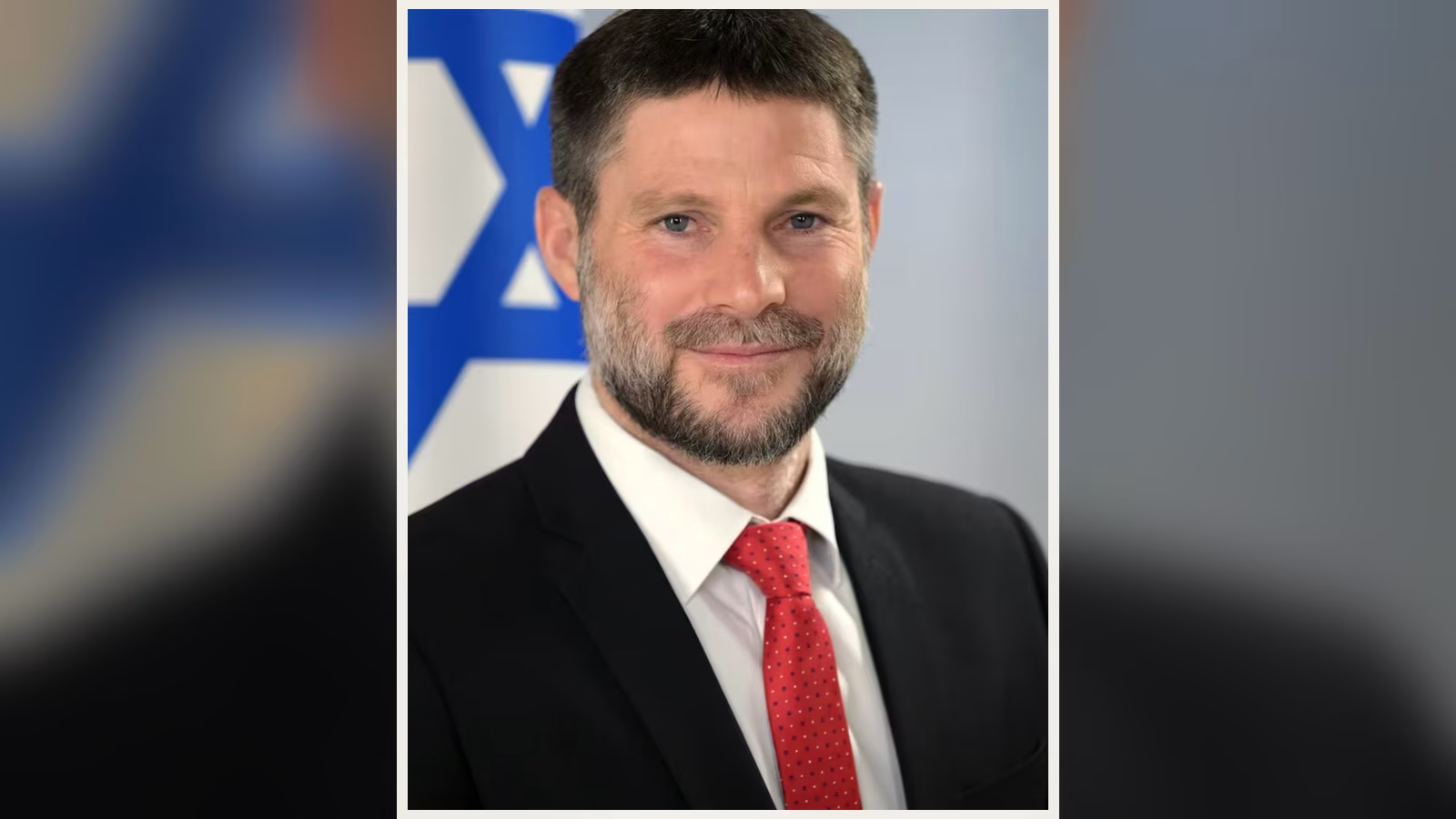
A minister with two political roles
Bezalel Smotrich has headed Israel's Ministry of Finance since the 37th government was formed at the end of 2022. He is also chairman of the Religious Zionism party and one of the coalition's most prominent ideological figures. Understanding his influence requires separating two levels. As minister, he is responsible for the budget, taxes, public debt and economic legislation. As party leader, he advances a broader programme on security, constitutional, religious and territorial issues.
These roles can reinforce one another, but they can also complicate negotiations with professional institutions and foreign partners. Companies generally watch fiscal decisions, incentives, tax changes and the exchange rate. Investors also assess political stability, the functioning of institutions and international relations. Smotrich's profile is therefore relevant even to readers who do not follow Israeli party politics but need to understand the business and investment environment.
His path to the Knesset and the transport portfolio
Smotrich was born in 1980 and studied law. He became publicly active on issues connected with religious Zionism and Israeli settlements and was first elected to the Knesset in 2015. He gradually became an important negotiator for smaller right-wing parties. His political views are the subject of sharp controversy in Israel and abroad, but describing them should not obscure the specific institutional powers he acquired upon entering government.
From 2019 to 2020 he served as transport minister. The portfolio gave him experience with large infrastructure projects, public procurement and planning, which later carried into his work as finance minister. Transport networks, railways and roads are not merely technical matters: they affect productivity, housing prices, access to jobs and regional development. During this period Smotrich presented himself as a politician who wanted to be associated with management and measurable performance in office.
The budget, deficit and the cost of security
The Ministry of Finance prepares the draft state budget, coordinates tax policy and oversees the spending frameworks of individual ministries. After October 2023 its work changed fundamentally because of defence expenditure, reserve mobilisation, compensation for businesses and reconstruction in affected areas. The budget debate therefore balances the need to fund security with maintaining services, investment and creditor confidence. The Knesset approved the 2026 budget after detailed coalition and opposition debate.
Smotrich stresses the resilience of Israel's economy, employment, investment and the capital market's ability to absorb extraordinary costs. A professional assessment must also track the deficit, the debt-to-GDP ratio, interest costs and the composition of spending. The Bank of Israel and international institutions publish independent analyses that need not match the minister's political interpretation. The most accurate approach is to compare government targets with actual budget data and forecasts.
Taxes, investment and the technology sector
Israel's technology sector generates a substantial share of exports, tax revenue and highly paid jobs. The Finance Ministry must therefore consider how to retain development centres, attract foreign capital and fund public needs at the same time. In 2026 it introduced measures focused on exports and high-tech in response to the strong shekel and changes in global taxation. Their practical effect depends on implementing rules, programme availability and business confidence in long-term stability.
The minister also influences tax relief, investment incentives, financial-market regulation and the terms of public funds. He does not directly control every instrument. The Israel Tax Authority, Capital Market Authority, Accountant General and Budget Department have their own professional responsibilities, while the Bank of Israel is independent in monetary policy. When the government speaks about supporting growth, political decisions, professional implementation and the private market's response should therefore be distinguished.
Ideology as an economic factor
Smotrich's positions on settlements, the Palestinian territories and the character of the Israeli state are a major part of his political identity. Supporters value his consistency and emphasis on national objectives; opponents point to social and diplomatic costs. Such disputes can have concrete economic effects: they change budget priorities, influence relations with foreign governments and enter investors' and rating agencies' assessments of political risk.
The controversy over judicial reform likewise showed that legal arrangements and economic expectations are not separate worlds. Some technology companies and economists warned that predictability could be weakened, while the government argued that reforms could restore balance between institutions. An editorial profile cannot settle that dispute in a single sentence. Its task is to show why the finance minister's statements about growth cannot be read without the political setting in which budget decisions are made.
What Czech companies should watch
Czech companies should monitor the Finance Ministry particularly for tax changes, investment-incentive rules, public budgets and funding for large infrastructure or defence projects. Direct commercial contact often runs through an Israeli partner, the Economy Ministry or a specialist agency, but the financial framework determines whether a programme has sufficient funding. Public-procurement rules, currency movements and possible changes in research and development support also matter.
Smotrich is an influential political actor, but Israel's economy is not managed by one person. The Bank of Israel, Knesset, courts, regulators, municipalities and a strong private sector all operate alongside the Finance Ministry. The official links in this article make it possible to verify his current role and government information; commercial decisions should supplement them with independent data, legal advice and sector-specific knowledge. This profile offers institutional orientation, not investment advice.
Sources and editorial note
The Jews.cz editorial team prepared this article from the public materials below. Claims made by a company or institution are explicitly distinguished from independently documented facts and editorial interpretation.