The commemoration connected towns and regions
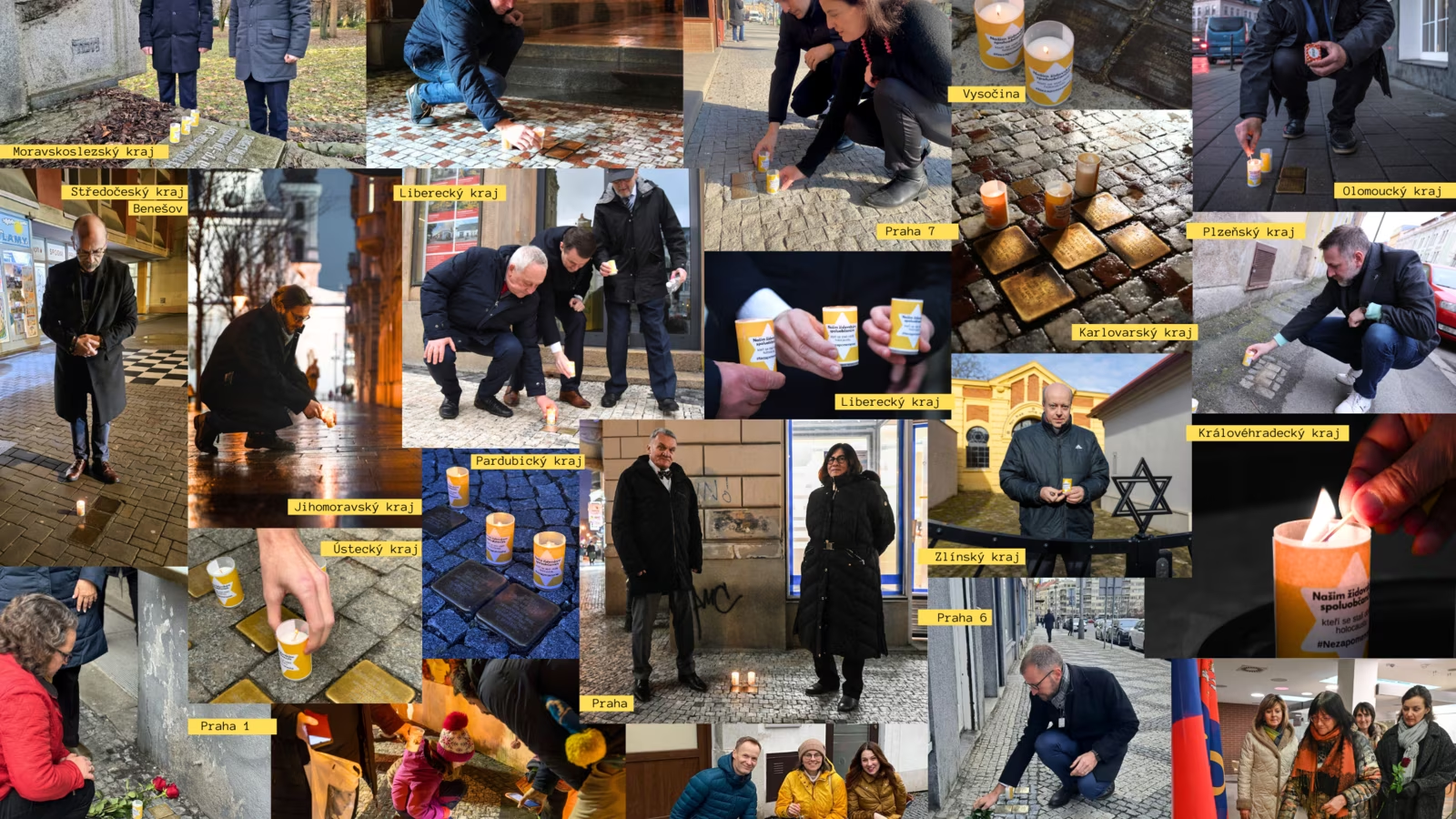
On 27 January 2024, candles were lit in Czech regions in memory of Holocaust victims. Individuals as well as representatives of Prague, its municipal districts and most Czech regions joined the appeal. The common gesture was visible precisely because it was not confined to a single ceremony in Prague.
The date marks the liberation of the Auschwitz-Birkenau extermination and concentration camp in 1945. The UN General Assembly established 27 January as an international day of remembrance in 2005. The Czech experience, however, is not merely an international subject: the tragedy has specific names and addresses and concerns communities that disappeared from towns in Bohemia and Moravia.
A symbol needs substance
A burning candle creates a space for silence and shared participation, but it cannot replace knowledge of history. It acquires meaning when combined with education, care for memorials, the reading of testimonies and the restoration of the names of people whom Nazi persecution erased from public life.
Restored synagogues, Jewish cemeteries, Stolpersteine and the work of regional archives belong in the same framework. Holocaust remembrance is therefore not just an annual event. It is a lasting local responsibility that can show that Jewish neighbours were not an anonymous group but part of a particular community.
Remembrance is not a political slogan
Historical memory should not serve as shorthand for judging every contemporary event. The Holocaust was a specific project of systematic persecution and murder of European Jews and other groups by the Nazi regime. Its meaning loses precision when the term is used as an everyday insult or a universal metaphor.
Factual knowledge is precisely what helps people recognise contemporary antisemitism without resorting to cheap analogies. Public candle-lighting therefore has its greatest value when it opens a path to local stories and to the responsibility of institutions to preserve them beyond the anniversary itself.
A public symbol needs names and stories
A candle is a shared and readily understood act, but it does not by itself say whom we remember. A local event gains depth when it works with victims' names, addresses, schools and professions. The Holocaust then appears not only as a distant number but as the destruction of a particular community. Every detail should be checked in a database or archive, and uncertainty should be acknowledged.
Stories should not reduce victims solely to the moment of their death. Photographs, letters and professional records can show life before deportation. At the same time, the rights and wishes of families must be respected. Organisers should cite their sources and not use an image without credit. A commemorative purpose is not an automatic exemption from responsible handling of personal material.
A nationwide initiative takes place in local settings
A common appeal can connect towns, schools and institutions, but every place has a different history. A programme in a municipality with no surviving synagogue will look different from one held near an active community or memorial. Local partners need room to choose the format and add relevant sources. A central organiser can provide methodology, graphics and verified educational materials, not a ready-made script unrelated to the place.
The number of participating locations indicates reach, but preparation and follow-up determine quality. A one-off candle-lighting can be an entry point to a school project, care for a cemetery or research into transports. Documentation should show not only guests of honour but also the context and public participation. The real outcome is continuing remembrance outside the anniversary.
Holocaust remembrance belongs with today's opposition to antisemitism
Historical education should explain the mechanisms of exclusion, propaganda, legal discrimination and violence. It should not use the Holocaust as a universal metaphor for every conflict, because that destroys precision. Its connection to the present lies in the ability to recognise antisemitism and conspiratorial thinking in today's language, protect Jewish communities and respond to specific incidents.
Support for remembrance must not become a test of agreement with the Israeli government. Jews in Czechia are not its representatives and must not be held responsible for decisions made by a foreign cabinet. It is equally possible to commemorate victims, support Israel's security and discuss current policy on its merits. Making these distinctions protects remembrance from instrumentalisation and public debate from collective blame.
Sources make remembrance verifiable
The embassy report documents the scale and institutional participation, while historical claims should also draw on museums, archives and victim databases. Each local story should link to a record where privacy rules permit it. Teachers and families can then continue the research and correct any error. Verification does not weaken memory; it is what keeps it credible.
Jews.cz retains the original date of the commemoration and does not present an old event as current. The article may be expanded with long-term projects and further sources, but any change must be transparent. A complete commemorative text brings together the event, history, local experience and present responsibility. The candle is its visible beginning, not its final word.
A map of commemorations can become a lasting educational resource
Individual places can be recorded with the date, organiser, public programme and links to verified local sources. A map should not turn the number of candles into a competition; it should help people find the story of their own municipality. Every entry needs a responsible editor and a way to submit corrections, because names, addresses or victim identifications in initial materials may be inaccurate. Photographs should be published with credit and without automated identification of participants who have not consented to it.
Schools can add a research result for the anniversary and show the following year what they managed to discover. Cooperation with memory institutions can supply methodology and protect sensitive information. The embassy may be a partner in remembrance, but historical data should come from specialist databases and archives. In this way, a visible symbol can become a verifiable network of memory that is not dependent on a single press release or one January event.
Sources and editorial note
This text was produced by the Jews.cz editorial team from the public sources listed below. It is neither a verbatim reproduction of those sources nor a statement by the source institution.
Date of the principal original source: 27 January 2024