When a willing relative is incompatible
Paired exchange helps when someone wants to donate a kidney to a loved one but is medically incompatible. By connecting several pairs, compatible combinations can be found and transplants performed across the original pairs.
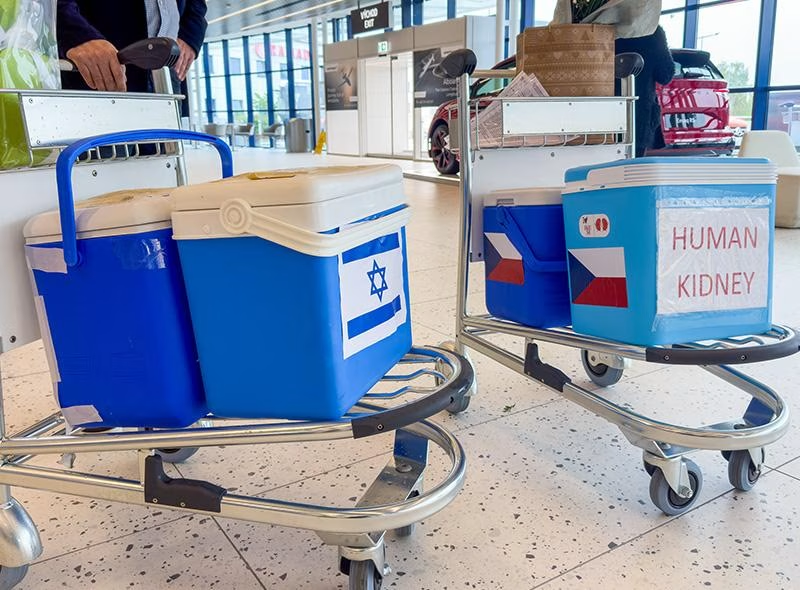
In the fifth Czech-Israeli exchange, two kidneys travelled from Czechia to Israel and two in the opposite direction. Another Czech pair joined the chain at Prague's IKEM, where the team operated on three donors and three recipients.
International cooperation expands the possibilities
Czechia and Israel completed their first cross-border exchange of this kind in 2019. By May 2024, published data showed that they had transferred a total of seven kidneys in each direction.
The purpose of cooperation is practical: a larger pool of pairs increases the chance of finding a suitable donor. Behind the diplomatic report lies the coordination of transplant centres, health professionals, donors and patients in both countries.
Paired exchange addresses biological incompatibility
A living donor may wish to help someone close to them, but blood type or an immune reaction may prevent direct transplantation. A programme connects several pairs so that each donor gives a kidney to a compatible recipient and their loved one receives an organ from another participant. The chain requires precise laboratory matching, logistics and confidence that every operation will take place in the agreed sequence.
An international exchange expands the pool and may find a solution for hard-to-match patients. It also adds borders, transport of biological material, different legal regimes and communication among teams. Success is not merely a surgical procedure. It begins with a reliable database and ends with long-term follow-up of donor and recipient under a shared clinical standard.
A donor's free choice is independently verified
A donor undergoes surgery without a direct medical benefit. They must understand short- and long-term risks, be free to change their mind and face no financial or family pressure. Independent psychosocial and medical assessments protect both the person and trust in the programme. Consent is not a one-off signature; it is verified during preparation and again before surgery.
A cross-border programme must not create payment for an organ or unequal access based on wealth. Travel and care costs can be reimbursed under the rules; payment for an organ is a different matter. Institutions should explain financing and criteria transparently. Personal health data require strict protection, so a press release should disclose only information to which participants have expressly consented.
Logistics must work as one clinical team
An organ has a limited preservation time and every transfer needs a backup plan. Teams coordinate retrieval, transport, operating rooms, laboratory results and possible changes in weather or flights. Some exchanges move an organ, others a donor. The choice affects medical risk and the burden on a person. Rehearsing the process in advance is as important as the matching algorithm itself.
If one link in a chain fails, other pairs may be affected. The programme therefore defines the point at which commitments become final, backup recipients and communication procedures. Clinical responsibility must remain clear between the Czech and Israeli sides. Shared documentation and insurance are not bureaucratic obstacles but conditions that allow trust among anonymous participants to rest on institutions.
One successful exchange raises the question of capacity
The fifth case shows that the partnership is not a one-off experiment. Further growth requires data on how many pairs the system evaluates, how often matching runs and the outcomes for patients and donors. Aggregate data can be published without compromising privacy. They will show whether international participation materially shortens waiting and which groups benefit most.
Transplant coverage should combine the human dimension with an accurate account of the system and not use a recipient as emotional scenery. The embassy report highlights the event; transplant centres should confirm medical data. Follow-up reporting belongs to long-term outcomes, ethics and coordinators' work. Their everyday infrastructure turns a diplomatic partnership into a concrete health benefit.
Long-term outcomes matter more than the number of exchanges
A clinical programme is judged by graft survival, the recipient's health and long-term donor care, not merely by a successful operation. Aggregate data after one, three and five years can show quality without revealing identities. Complications, waiting time and the proportion of hard-to-match patients matter. The label “fifth exchange” demonstrates continuity but does not by itself enable comparison with domestic matching or another international network.
The editorial team will verify medical claims with transplant centres and specialist publications, while using the embassy report for the date and diplomatic context. A participant's story should be told only with free consent and without pressure to reveal sensitive details. Full reporting should give space to coordinators, laboratories and ethical rules that remain behind a hospital photograph. This systemic work explains why trust between two countries can be converted into a safe clinical chain.
It will also be useful to compare waiting time and logistical costs with the benefit of a larger registry. An international route makes sense if it increases the likelihood of a compatible pair or accelerates transplantation without reducing safety. These data can support further agreements while showing the point beyond which a more complex chain brings too little benefit. A public methodology would enable comparison with other European programmes and help patients understand when they may be included.
Source and editorial note
This text is an editorial summary of information published by the Embassy of the State of Israel in the Czech Republic. It is neither a verbatim press release nor an expression of the editorial team's position.
Date of the original source: The original report was published on 9 May 2024 and last updated on 23 May 2024.