Masaryk and the emergence of a Jewish state
Czech support for Israel is often described as a self-evident tradition. The actual history is more valuable because it was not straightforward. It contains personal courage, state decisions, broken continuity and a return to cooperation after Communism fell.
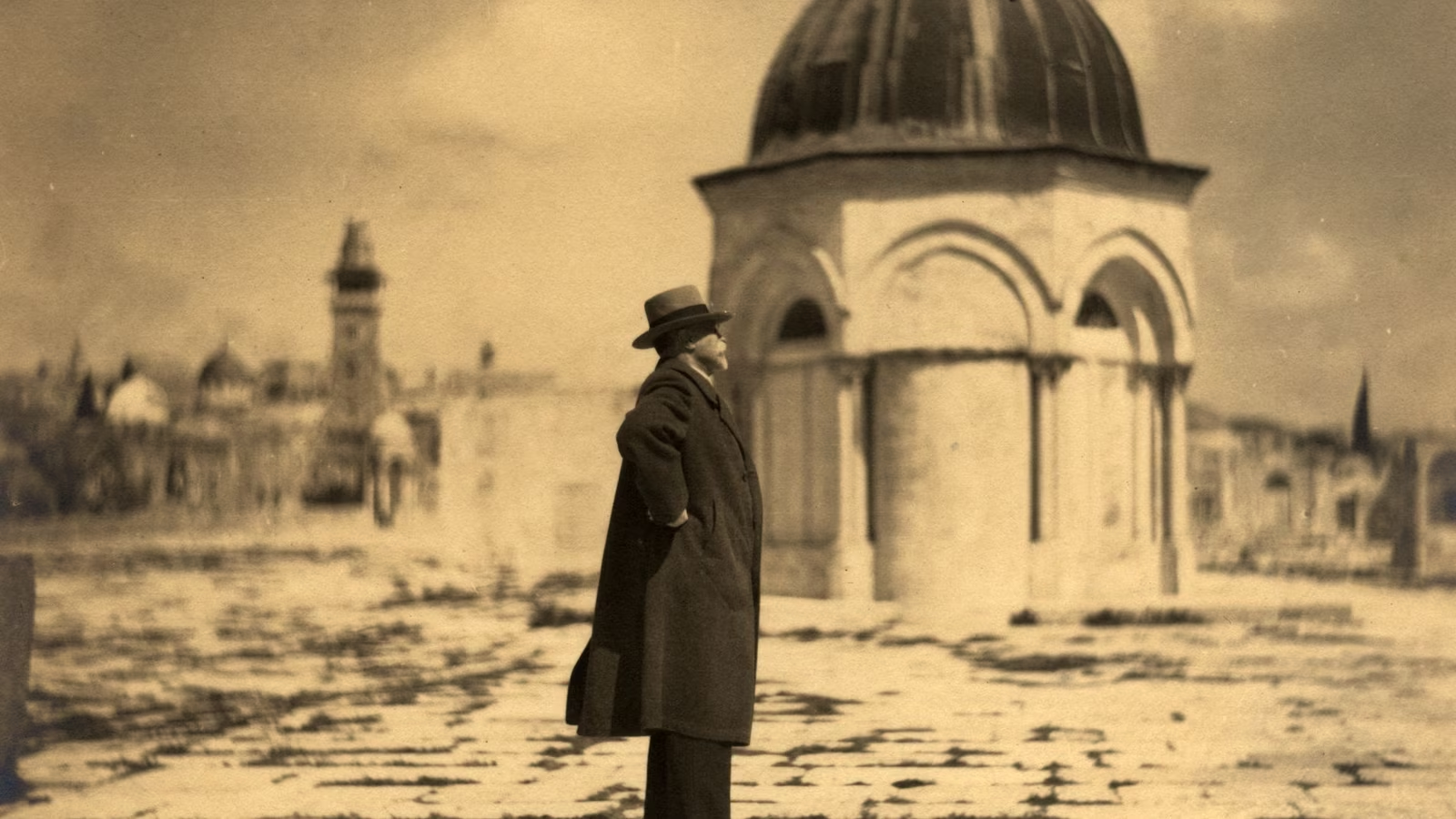
Tomáš Garrigue Masaryk visited Mandatory Palestine in 1927 and encountered local Jewish communities and the Zionist project. His journey created an important symbol of the relationship before the State of Israel existed.
The Czechoslovak government recognised Israel on 19 May 1948, five days after its declaration of independence. The young state subsequently received military supplies and training. At a time when Israel was fighting for survival, this was concrete assistance rather than merely a diplomatic gesture.
Broken continuity
Czechoslovak policy changed after the Communist takeover. The regime aligned its approach to Israel with the Soviet line, while the foreign-policy turn was accompanied by antisemitic repression at home. This chapter must not disappear from the story, because doing so would turn support for Israel into a comfortable myth without responsibility.
Diplomatic relations were severed in 1967 and restored only in 1990 after the Communist regime fell. More than two decades of interruption show that closeness between countries is not a natural permanent state. It depends on political freedom and a willingness to reject both antisemitism and ideological distortion.
A partnership for the present
Today's relationship rests on more than the memory of 1948. It includes political contacts, economic exchange, scientific cooperation and links among institutions and people. This breadth gives the partnership more resilience than a one-off declaration by any government.
Friendship with a state does not mean automatic agreement with every action by its cabinet. Czech society can support Israel's right to exist and be secure, work with its institutions and still assess particular political decisions on their merits. We expect the same distinction from partners looking at the Czech Republic.
Czech-Israeli ties are strongest when grounded in memory and concrete work rather than empty gestures. Masaryk's journey, the assistance of 1948, the experience of Communist antisemitism and today's cooperation form one story,not a flawless one, and therefore all the more binding.
Masaryk's journey became a symbol over time
The 1927 visit to Mandatory Palestine had a contemporary diplomatic and personal context. Later Czech-Israeli memory turned it into a major symbol recalled in speeches and at memorial sites. Historians must distinguish what Masaryk actually said and did from the meaning later generations assigned to the event. Both are legitimate subjects, but they are not the same.
The journey fits Masaryk's stance against antisemitism and Czechoslovakia's relationship with Jewish communities. It also preceded the Holocaust, Israel's creation and the post-war order. Using it as direct guidance for today's policy would be anachronistic. Its enduring value lies more in a public gesture of respect and a willingness to recognise emerging institutions.
Memory of assistance must not conceal the regime's reversal
The supplies and training of 1948 are rightly remembered as a concrete Czechoslovak contribution. Yet after Communism consolidated power, the same state adopted a different line and political trials used antisemitic themes. Both chapters belong to one story. Selecting only the heroic part would depict a nation without responsibility and silence the experience of victims of domestic repression.
Institutions today can make this memory more precise by digitising archives, teaching and collecting testimony. Names, dates and decision-making structures should be preserved. General claims of traditional friendship are useful as an introduction, not as the final historical account. Readers should be able to reach the documents and recognise where sources or interpretations diverge.
Today's partnership rests on a dense institutional network
The strength of a relationship can be seen in stable links among universities, hospitals, companies, local authorities and cultural institutions. Cooperation that exists only between prime ministers is vulnerable to electoral cycles. Multiple independent connections create continuity and allow a dispute to be managed without severing the entire relationship. Reciprocity also matters so that one country is not merely an audience or customer.
Trade figures, joint grants and long-term projects are better measures than the number of friendly statements. At the same time, not every cultural or commemorative activity needs to yield an economic return. Different pillars have different purposes but can reinforce one another. A research partnership, for example, may build on political trust and later create a company or clinical practice.
Friendship and critical precision are compatible
Supporting Israel's right to a secure existence is not consent to every decision of every government, just as the Czech state cannot be equated with one cabinet. A historically grounded relationship is confident enough to distinguish institutions, responsibility and citizens' views. Criticism of a particular policy can be factual, while delegitimising the state or expressing antisemitism crosses a different boundary.
A magazine should explain these boundaries through documented cases rather than hide behind a slogan. Coverage of bilateral relations must cite primary sources from both countries, add specialist literature and acknowledge uncertainty. A different kind of reporting is not an excuse for a lower standard; it means greater attention to memory, commercial context and the distinction among state, government and society.
A remembrance series can connect places, documents and people
Masaryk's journey, the assistance of 1948 and the restoration of ties after 1990 can each become a report from Czech and Israeli locations. Every instalment should begin with a document and add a present-day interview with a historian or custodian of memory. The aim is not to repeat a familiar symbol at greater length but to show how it arose, who preserves it and what it means today. Competing interpretations should be identified, not hidden behind ceremonial wording.
At present-day anniversaries, it is worth asking whether a legacy leads to a concrete project in education, science or heritage care. A symbolic visit can matter but cannot substitute for a long-term programme. Jews.cz will identify partners, funding and subsequent outcomes. Historical closeness can thus remain part of the magazine's identity while still facing the journalistic question of how memory translates into present responsibility and practical cooperation.