Two Israeli technology branches reunite
Mobileye announced its agreement to buy Mentee Robotics in early January 2026. Professor Amnon Shashua co-founded both companies, so this brings together teams rooted in a similar school of computer vision and machine learning. Mobileye wants to develop humanoids for environments designed around people alongside automotive autonomy.
The cash-and-shares deal remained subject to customary conditions. It provides a team and technology, not a guarantee of affordable robots quickly entering factories, warehouses or homes. Humanoid robotics still attracts more capital and attention than mature commercial deployment.
What a car and a humanoid share
Both must turn camera and sensor data into a model of their surroundings, recognise space, objects and people, predict motion and plan an action. A car largely follows a road network and standard controls; a humanoid must handle uneven floors, doors, stairs, tools and varied objects while maintaining balance.
Mobileye contributes sensor processing, maps, safety logic and automotive-grade industrialisation. Mentee develops an architecture joining perception, planning and whole-body control. Physical-world models may be shared, but training data, hardware, safety standards and the consequences of error differ by use.
Physical AI is harder than a chatbot
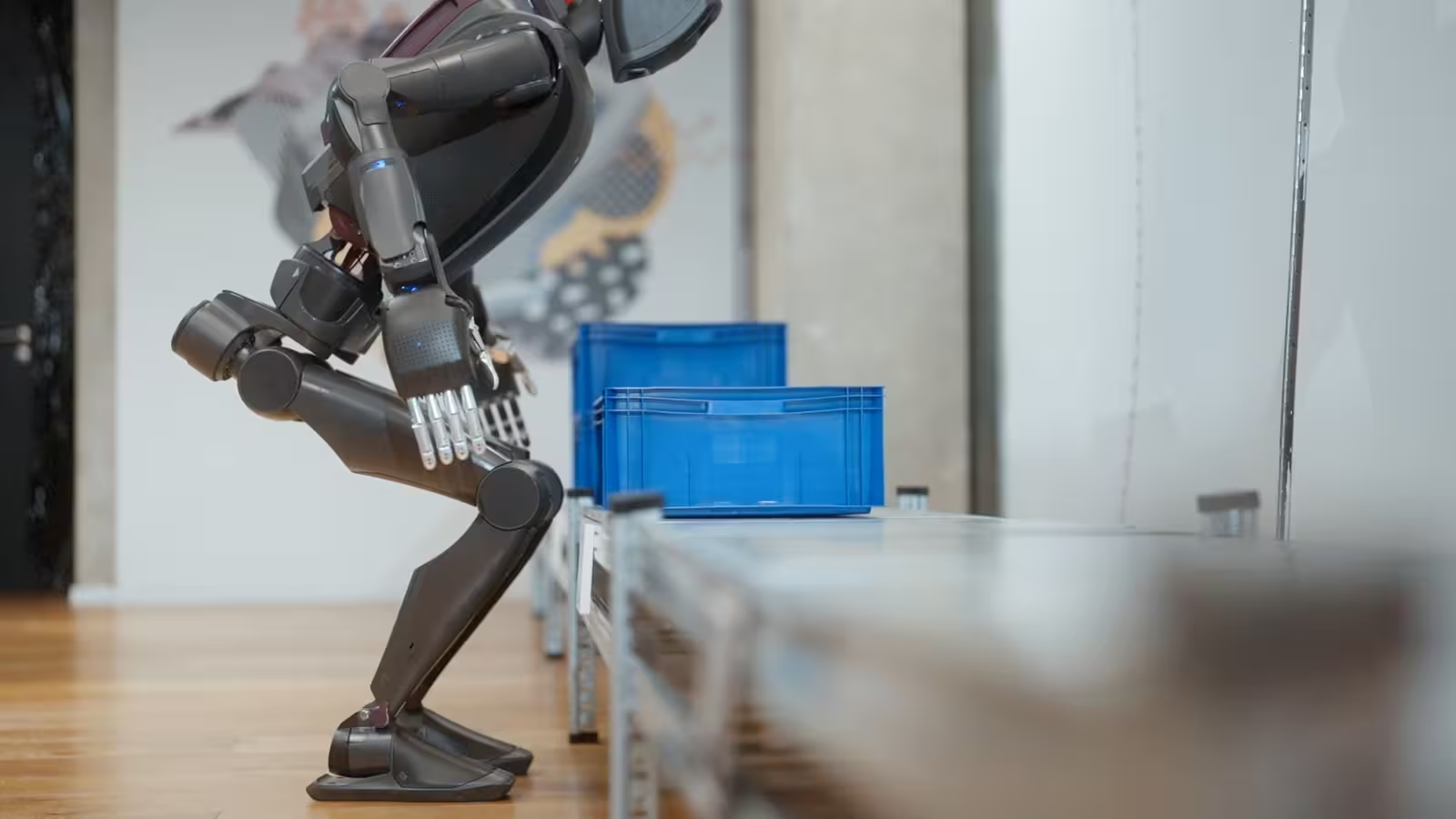
A user can correct a bad generated sentence; a machine lifting a crate turns computation into physical action. It must estimate uncertainty, stop for unexpected obstacles and fail predictably. Glare, dust, wear or a different table height can transform a task that looked simple in the laboratory.
Mentee uses video, simulation and human demonstrations so movements need not all be hand-coded. The real questions are repeatability, time between failures and the amount of human supervision,not whether a robot succeeds once in a demonstration.
The first market is unlikely to be the ordinary home
A humanoid promises a general helper using human spaces and tools, but early economics favour controlled manufacturing, logistics or laboratory settings. There customers can calculate labour, downtime and errors, constrain the space and begin with a limited task.
Mobileye already works with industrial customers that buy complex hardware, but robotics may require site-specific process changes. The company must decide whether to sell a complete robot, license an intelligence layer or build an ecosystem of integrators and manufacturers.
The acquisition expands both opportunity and risk
Robotics offers Mobileye another future revenue source and a use for perception research, but adds costly mechanics, actuators, whole-body control and service. Investors must judge whether the teams complement each other or divide management between two difficult commercial paths.
Demonstration videos reveal little about cost, safety or demand. Paid pilots, operating hours, autonomous task completion and human interventions are better milestones. As a public company, Mobileye will eventually expose spending, contracts and financial impact as well as marketing.
Israel's ecosystem can supply more than a robot maker
The deal shows expertise in vision, chips and autonomous transport spreading into other fields. A humanoid supply chain needs sensors, gears, batteries, safety software, simulation, cyber protection and enterprise integration. Supplying one layer may be more realistic than building the whole machine.
Czech engineering, automation and integration expertise could support handling tests, components, safety validation and deployments. Cooperation should begin with a precise task, cost and risk. Mentee matters because it joins Israeli software ambition with a physical product governed by industrial discipline.
Sources and editorial note
The Jews.cz editorial team prepared this article from the public materials below, distinguishing company claims, independently documented facts and editorial interpretation.