A quantum chip needs a classical control system
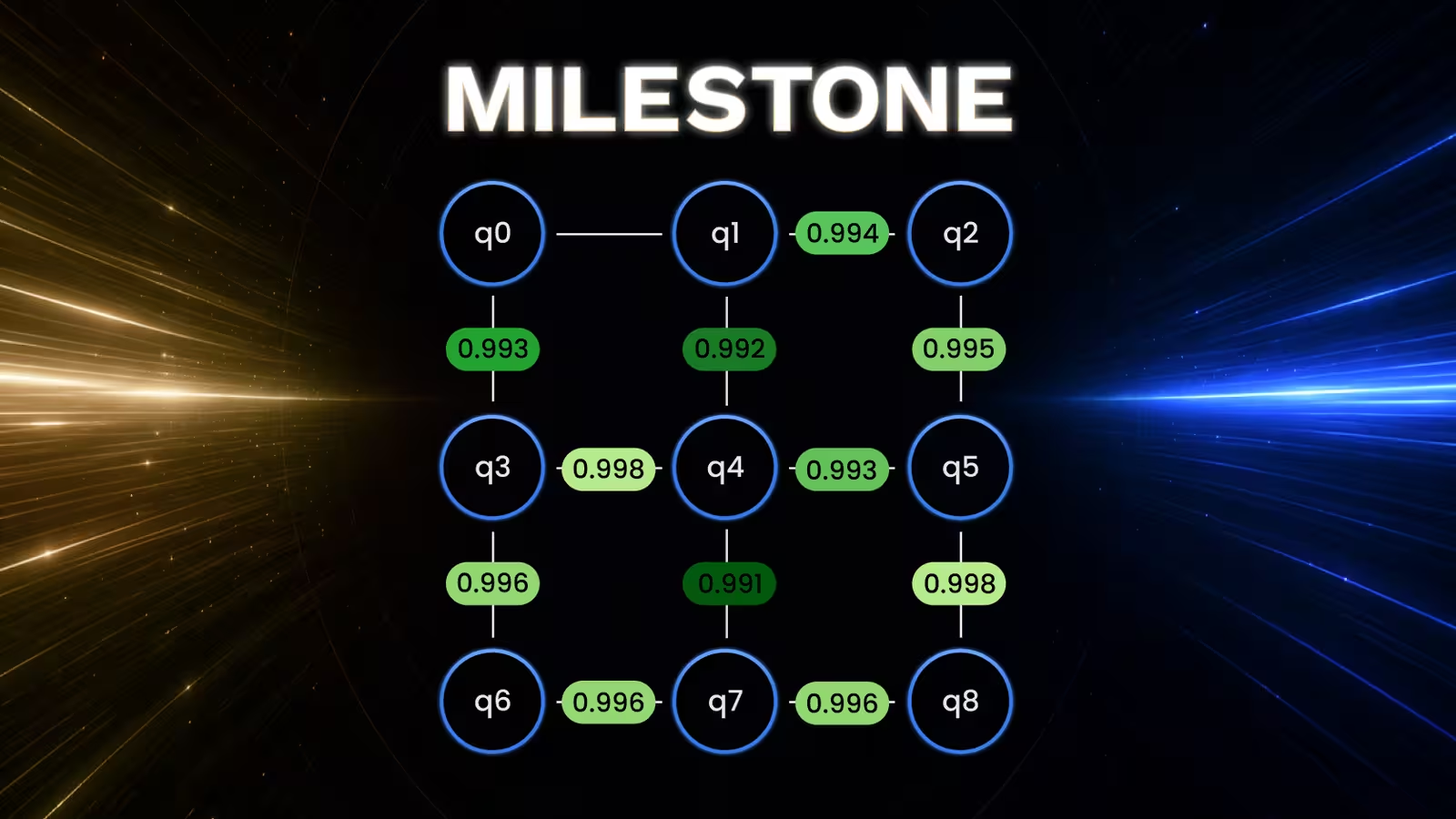
Quantum Machines said in May 2026 that OPX1000 and QUAlibrate had operated Rigetti's commercially available superconducting Novera processor with median two-qubit gate fidelity of 99.5 per cent. Qubits sit in a cryogenic environment, but classical electronics and software create their pulses, timing, measurement and feedback.
Control must generate exact analogue signals, synchronise channels and rapidly process readings. A good QPU still needs whole-system calibration. Quantum Machines sells this orchestration independently of a particular qubit type; the Novera result supports interoperability rather than proving a universally solved quantum computer.
Fidelity describes the accuracy of an operation
Two-qubit gates enable quantum algorithms and are usually noisier than single-qubit operations. A 99.5 per cent median is a low average deviation, but errors accumulate, and the median hides the worst pair and drift. Distribution, gate count, benchmark method and recalibration repeatability matter.
This is a system milestone, not practical quantum advantage. Useful algorithms may need vast numbers of logical operations and error correction. Better physical fidelity still reduces overhead and permits harder experiments, while rapid automatic restoration of a good state saves laboratory time.
QUAlibrate automates repetitive tuning
Calibration searches frequencies, amplitudes, pulse lengths and readout parameters that drift with environment and age. QUAlibrate describes, runs and evaluates reproducible procedures, saving expert time while remaining adaptable to each processor.
OPX1000 generates and processes signals at low latency for feedback during experiments, important to adaptive circuits and future error correction. Channel count, synchronisation, frequency support, programming and scaling remain customer questions; one small QPU is only a foundation.
A more open ecosystem reduces laboratory risk
A research centre may want to change QPUs without replacing control hardware and software. An independent platform can preserve experiments and compare vendors if procedures, formats and calibration transfer without extensive rewriting.
Tight chip-vendor integration may optimise faster, while an open supplier must support many architectures. Quantum Machines' advantage therefore lies in the quality of its abstraction and support, demonstrated by reproducible results that still expose necessary low-level parameters.
The business resembles laboratory infrastructure more than a consumer chip
Quantum customers are mainly research institutions, state programmes and system builders, with long sales cycles, low volumes and intensive support. Quantum Machines can sell hardware, software and integration without winning the contest for the best qubit, a resilient position if architectures remain diverse.
Installations, repeat orders, software adoption, service cost and scaling matter more than the sector's total qubit count. Joint diagnostics must separate chip, cabling, cryogenic and control faults and clarify who is responsible for end performance.
Czech research can use an open control layer
Czech quantum programmes may need control electronics, calibration, microwave engineering and links to classical supercomputers. Cooperation can cover experiments, software tests, education or integration of a particular QPU rather than buying an entire computer.
99.5 per cent is not the percentage of a completed quantum computer; it describes one operation on one setup. The broader product story is still strong: tools for repeatedly controlling and measuring new chips may create a lasting infrastructure business before quantum computing becomes routine.
Sources and editorial note
The Jews.cz editorial team prepared this article from the public materials below, distinguishing company claims, independently documented facts and editorial interpretation.