The research began with a question outside the tumour itself
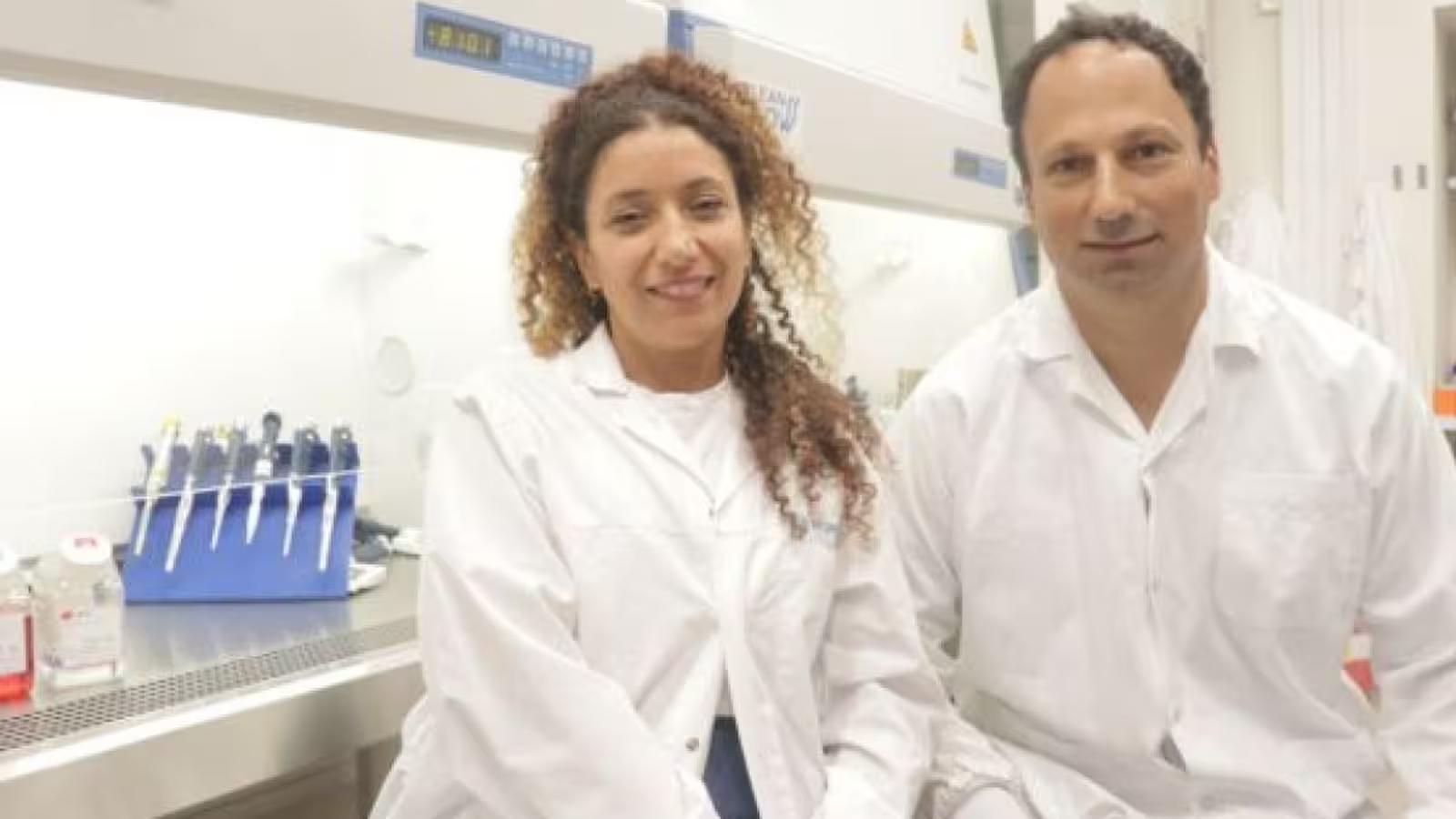
A Tel Aviv University team led by Carmit Levy, Yaron Carmi and doctoral student Avishai Maliah studied how ultraviolet radiation suppresses immune responses in skin. In a mouse model they observed increased Ly6a protein on T cells and hypothesised that it acted as a brake. Finding a similar increase in the tumour environment, they connected the two fields and tried blocking the mechanism with an antibody.
According to the university summary, the intervention substantially reduced melanoma and colorectal tumours in model animals, including models resistant to PD-1 treatment. The result appeared in the peer-reviewed journal Nature Communications. This is an important preclinical finding, not a treatment ready for patients. A headline about “eliminating tumours” describes an experimental model and must not be read as proof that human cancer has been cured.
T cells need both activation and brakes
The immune system must attack threats without damaging the body's own tissues, so T cells receive activating and inhibitory signals. A tumour can exploit natural brakes to evade immune surveillance. Checkpoint inhibitors such as PD-1 therapies release some of them and have transformed outcomes for some patients. Many tumours do not respond or develop resistance, prompting a search for additional control mechanisms.
Ly6a is a protein used in mouse models, and translating the finding to humans is not straightforward. Researchers must identify a corresponding human target, verify its presence and determine whether blocking it would cause unacceptable autoimmunity or damage healthy tissue. The finding identifies a biological path to investigate; it does not say that the mouse antibody will become a human medicine. Translating the mechanism accurately is a separate scientific stage.
PD-1 resistance matters, but only within the model
The university highlights responses in PD-1-resistant models because insufficient response limits immunotherapy today. A new target can suggest that tumours use several parallel brakes and that combined intervention might restore T-cell activity. It may also increase toxicity by disturbing several controls across the body. Further studies must compare individual and combined treatment and measure more than tumour size.
Preclinical models simplify human disease and may not capture patient diversity, previous treatment or other illnesses. A result is stronger when repeated across models and human samples. Drug development also needs a biomarker to select patients most likely to respond. Without one, a promising mechanism present in only some tumours may disappear in a broad trial or expose many people to risk without benefit.
Drug development has several expensive gates
After a biological discovery, developers must create a molecule suitable for humans and test binding, manufacturing, dosing and toxicology. An application for a first clinical trial follows, then successive safety and efficacy phases. In oncology this can take many years, and most early projects never reach registration. A university may license the technology or found a spin-off, but commercial value will depend on patents, the human target and the quality of further data.
Investment reports sometimes value early research by the size of the oncology market, an estimate far removed from this stage. Reproducibility, intellectual-property protection and a partner able to finance translation matter more. Public grants and university infrastructure bear early risks often accepted by private capital only after clearer evidence. The Tel Aviv University story also illustrates a path from basic immunology to a possible biotechnology opportunity.
A press release must be read alongside the paper
The university communication explains the unexpected discovery clearly and quotes the lead scientists. Accurate assessment nevertheless requires the original study: methods, group sizes, statistics, figures and limitations. “Tumour” covers hundreds of biologically different diseases, and two models cannot represent them all. The date also matters because other laboratories may confirm, refine or challenge the finding.
Responsible reporting does not repeat emotional language about new hope without a timeframe. Patients should not change treatment or seek a non-existent antibody outside a trial on the basis of this report. The practical result is a new direction for researchers and a potential target for drug developers. A future clinical trial would have precise criteria and oversight. Until then, the chief value is better understanding of how a tumour suppresses immunity.
Czech-Israeli cooperation can be research, not advertising
Czech oncology, immunology and medicinal-chemistry centres could help verify the mechanism, analyse human samples or develop molecules. A useful partnership needs a shared protocol, predefined outcomes and rules for data and intellectual property. There is no need to wait for a finished product: independent replication and translation are precisely where international science creates value and lowers later development risk.
The Ly6a discovery suits coverage of Israeli innovation only when scale is preserved. It shows an original hypothesis, a strong academic setting and a possible route to a product while reminding us that most work is still ahead. The gap between a mouse tumour and a safe human drug is the main development challenge, not a formality. Follow-up should track the human target, licensing, preclinical safety and any trial registration.
Sources and editorial note
This article was prepared by Jews.cz from the public materials listed below. Company or institutional claims are explicitly distinguished from independently documented facts and editorial interpretation.