The old language never became completely silent
For centuries Hebrew served prayer, study, poetry, letters, and communication between distant Jewish communities. It was not the ordinary mother tongue of most people, but it did not disappear. Modern revival did not create a language from nothing. It expanded its functions into homes, schools, commerce, newspapers, and politics.
Ben Yehuda began with his family
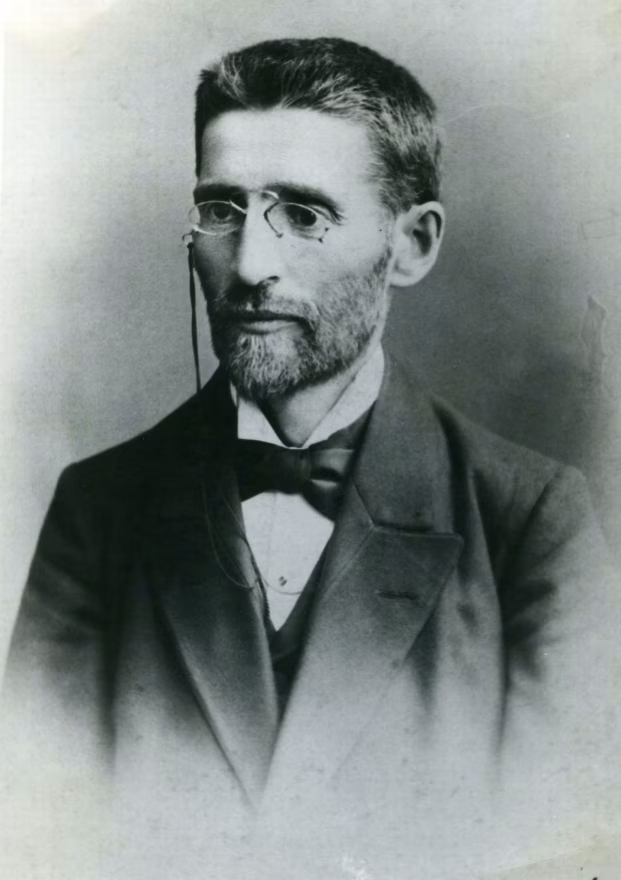
After arriving in Palestine in 1881, he promoted Hebrew for daily speech and used it at home. He published newspapers, sought words for modern objects, and worked on a large dictionary. His determination attracted both support and opposition. He became a symbol because he connected a personal experiment with a public campaign.
School turned the project into generational change
The decisive shift came when children studied several subjects in Hebrew and used it with one another. Teachers had to create terms for mathematics, science, and administration. The Language Committee tried to standardize new words, yet actual acceptance always depended on what ordinary people began to say.
Contemporary Hebrew carries many sources
Pronunciation, vocabulary, and sentence structure developed through contact with Yiddish, Arabic, Russian, Ladino, and other languages. Asking whether this is a revived ancient language or a new mixture simplifies a living process. Modern Hebrew connects with old texts while carrying the experience of speakers from many countries.